

Reported ranges, not measured on any one store. The disproportion between the first two bars is consistent across sources even where the exact figures are not.
Somewhere between 15% and 30% of visitors use a store's search box, and compilations that measure it put them at 40 to 45% of revenue, converting at roughly 4.6% against 2.8% for everyone else. They are the highest-intent traffic you get. Between a tenth and a fifth of their searches return nothing, and best practice is under 5%. Every one of those is a visitor who arrived knowing exactly what they wanted and was told the store does not sell it, which for most stores is not true.
Who these visitors are
Site search is usually treated as a utility, a box in the header for people who cannot be bothered to browse. The measured behaviour says something different.
A shopper who types into your search box has done three things a browsing shopper has not: decided what they want, named it, and asked you directly. Compilations that track this put searchers at roughly 4.6% conversion against 2.8% for non-searchers, and at 40 to 45% of revenue despite being a minority of visitors.
Search is not a convenience feature. It is the channel your most decided customers arrive through, and it is usually the least maintained surface in the store.
A visitor who typed your product's name into your search box is the closest thing to a guaranteed sale your store will see all day. The Dropshipping Playbook
The zero-result page is the loss
Now the other half. Published estimates put the share of searches returning nothing at 10 to 20% on a typical store, with under 5% described as best practice. Compilations also report that a large majority of shoppers who hit an unsuccessful search go and buy elsewhere rather than trying again.
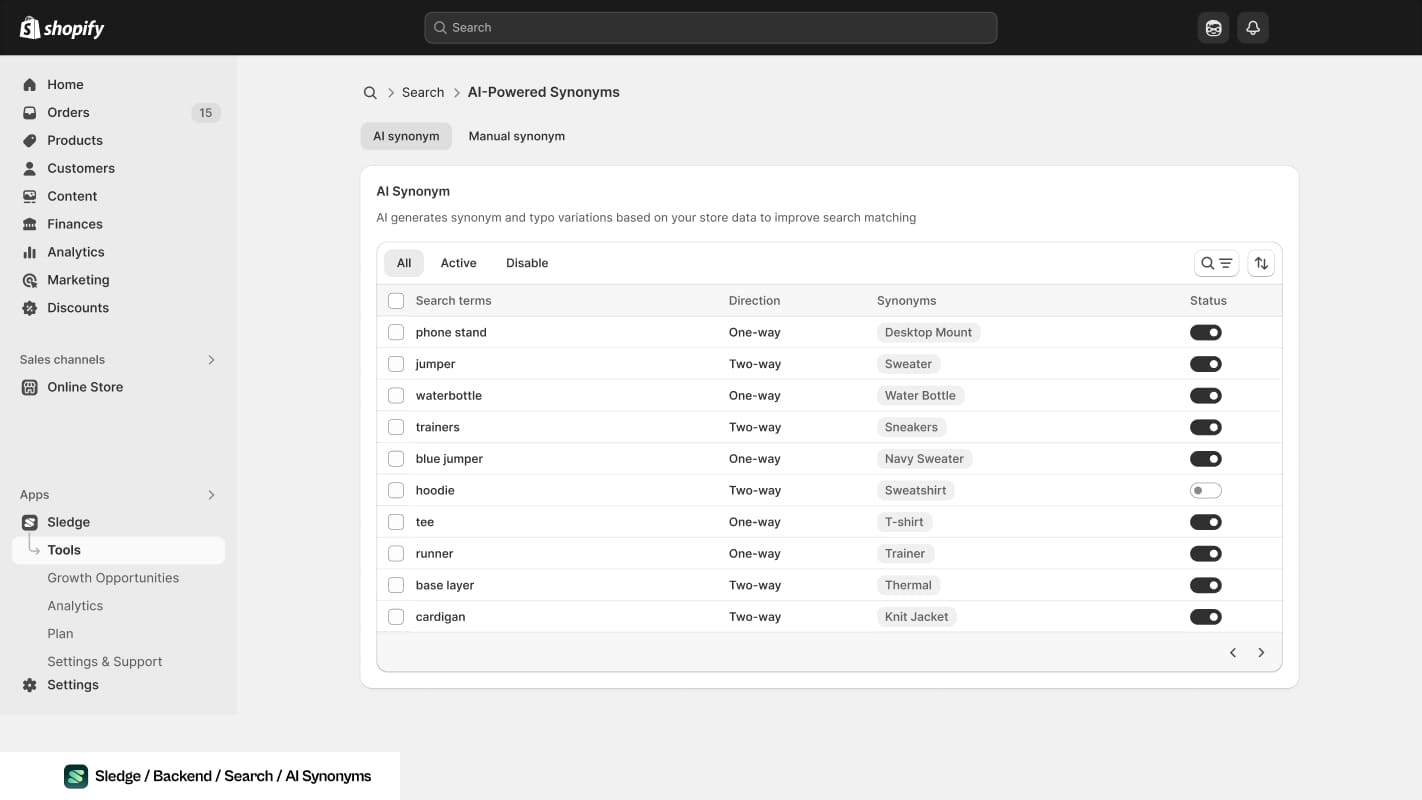
Ten mappings, each a word a shopper types that the catalogue does not. The first two rows of the table below get fixed here, without retitling a product.
Put those together and the shape of the problem is specific: your highest-intent visitors, at a rate of roughly one in six, being told the store does not have the thing it has.
Because that is what it usually is. Not a missing product, a missing word:
| What they typed | Why it failed | Fix |
|---|---|---|
| "phone stand" | Product is titled "Desktop Mount" | Synonym, or retitle |
| "waterbottle" | No space, no match | Misspelling tolerance |
| "blue jumper" | Colour is a variant, not indexed | Index variant attributes |
| "under 30" | Price is not searchable text | Route to a filtered collection |
| "returns" | Search covers products only | Include pages in results |
| "nike" | You genuinely do not sell it | Show alternatives, per chapter 4.12 |
Five of those six rows are stores failing to recognise their own products. The last one is the only honest miss, and even that one has a better answer than a blank page.
The unglamorous fixes, which are most of the gain
Search vendors sell semantic matching and machine learning. On a dropshipping catalogue of a few hundred products, most of the available improvement is in work that costs nothing but attention.
- Rewrite product titles in customer vocabulary. Supplier feeds arrive in supplier language and it survives into your index unless somebody changes it
- Add synonyms for your top twenty products, including the words a beginner in your category would use rather than an enthusiast
- Turn on misspelling tolerance, and check it works on your own hardest product name
- Index variant attributes, so colour, size and material are searchable, not buried in a dropdown
- Include content pages, so "shipping", "returns" and "contact" resolve to a page
- Make the search box visible on mobile without a tap on an icon, if search is carrying real revenue
Rows one and two are the highest-value hour available here, and both are free. They also improve navigation and organic search at the same time, since the words are the words either way.
Do not merchandise over the top of a query
A common and costly configuration: search results sorted by best seller rather than by match.
The reasoning sounds sensible, in that best sellers convert. The effect is that a shopper who typed a specific term gets your most popular products instead of the one they named. You have taken the clearest statement of intent available to you and overridden it with an average.
Relevance first. Use popularity to break ties between equally good matches, which is where it genuinely helps. Chapter 4.11 covers where sort order does belong.
If your search box shows suggestions as people type, those suggestions are doing more work than the results page, because most shoppers pick one rather than finishing the query. A suggestion list built from your product titles inherits every vocabulary problem in the table above, one step earlier.
The three numbers to track
- Search usage rate. What share of sessions used it. A sudden climb usually means navigation broke, per chapter 3.5.
- Zero-result rate, and the ranked list of which queries produced it. This is the actionable one, and it is a work queue rather than a metric.
- Search conversion rate against site conversion rate. If searchers are not converting better than browsers, your results are not answering the question, and no amount of usage growth will help.
All three depend on something recording queries, and none of them can be reconstructed later. That is the same constraint as everywhere in this level, and it is why chapter 3.4 ends on the same sentence: the only day you can start is today.
Common questions
How do I find out what people search for?
What is an acceptable zero-results rate?
Do I need an AI search app?
Should search results be sorted by relevance or by best seller?

The app behind these fixes
Most of Level 04 is a setting in Sledge rather than a project.
See it on the Shopify App Store