

Illustrative curve, not plotted data. What is well supported is the shape: steep at the start, flat after a handful.
The frequently cited Spiegel Research Center finding is that purchase likelihood rises sharply as a product goes from no reviews to around five, then flattens. That shape matters more than any headline percentage, because it tells you where the work is: five reviews on each of twenty products beats a hundred reviews on one. It also rules out the shortcut, because importing reviews is one of the specific flags that appears in Shopify store-termination threads, which makes it a risk trade rather than a growth tactic.
The shape, not the headline number
Social proof statistics are among the most enthusiastically quoted in ecommerce, and most of the headline figures come from companies selling social proof software. Percentages in the 10 to 30% range for adding reviews to a page are widely reported; you will also see much larger claims, and those are worth reading with the source in mind.
The finding worth building on is not a percentage at all. It is the Spiegel Research Center observation that purchase likelihood climbs steeply as a product goes from zero reviews to a handful, and then flattens.
That shape changes what the work is:
| Situation | Marginal value of one more review | What to do |
|---|---|---|
| Product with 0 reviews | Very high | This is where all the effort goes |
| Product with 1 to 4 | High | Keep asking |
| Product with 5 to 10 | Moderate | Good enough. Move on |
| Product with 40+ | Near zero | Stop. Go find a product with none |
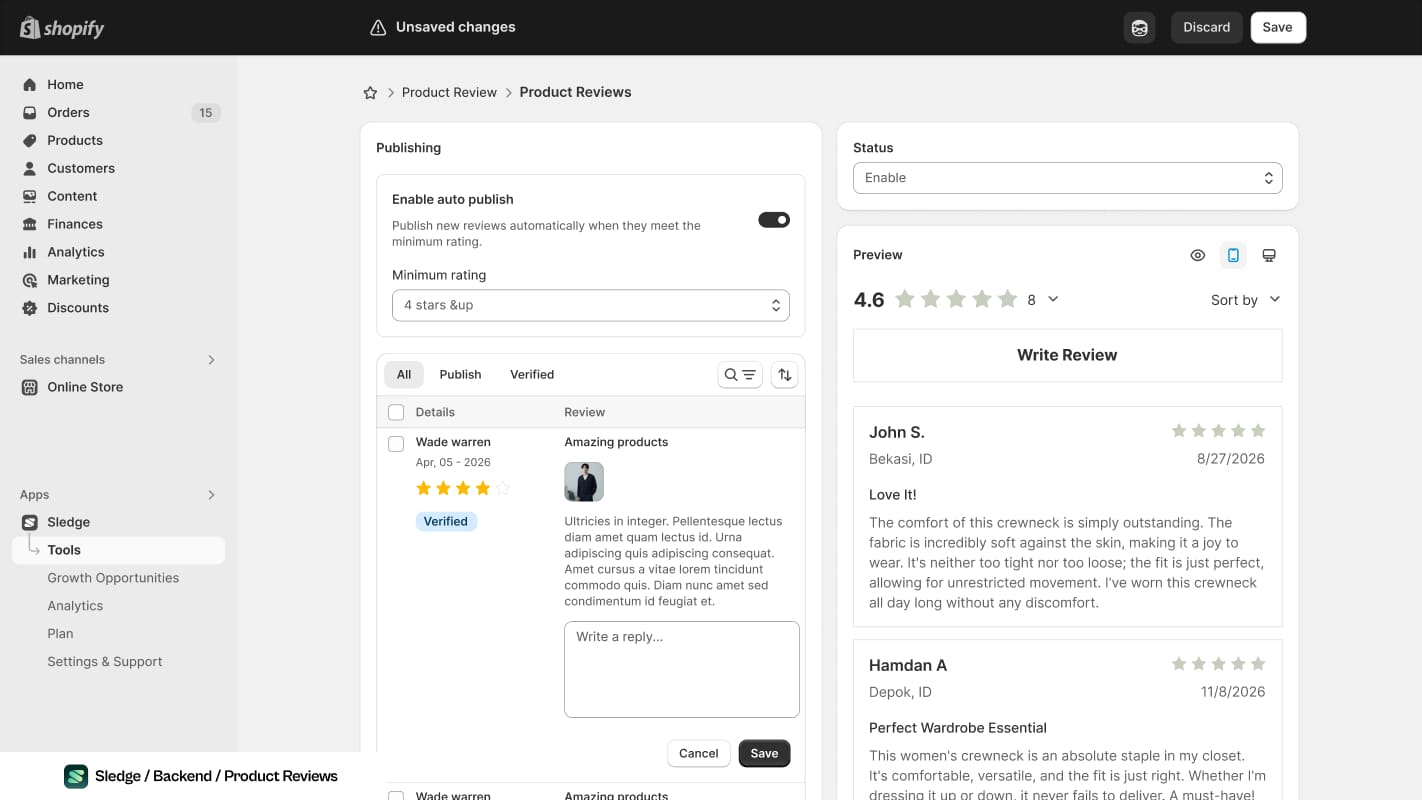
The table above says which products to chase. This screen is where the reviews that arrive get published and answered.
Five reviews on twenty products beats a hundred reviews on one. The curve is steep exactly where most of your catalogue is sitting. The Dropshipping Playbook
Most stores do the opposite. Review requests point at the best seller, which already has plenty, while the products in the steep part of the curve stay at zero and keep converting badly, which confirms they are weak products, which is why nobody promotes them.
The shortcut, and what it actually costs
Importing supplier reviews is a button in several dropshipping apps, and it solves the cold-start problem in one click. It is also, per chapter 1.3, on the short list of patterns that recur in store-termination threads: imported or fabricated reviews, cloned or purchased templates, ads that do not match the landing page.
Treat it as the trade it is rather than as a moral question:
Getting real ones, from a small store
The mechanism sits in the post-purchase window from chapter 4.6, and the details matter more than the tool.
- Ask after delivery, not after purchase. For a dropship lead time those can be two weeks apart, and asking on day one gets you a review of your checkout
- Ask once, with one follow-up at most. A third request converts a happy customer into an annoyed one
- Make it answerable in two lines and on a phone. A form with five fields gets reviews from nobody
- Ask a specific question rather than "how was it": what they were replacing, what they use it for, what surprised them
- Never condition it on the review being positive. That is a different thing with a different legal exposure
- Point the requests at products with zero to four reviews, not at whatever sold most this week
Proof that is not a star rating
Reviews are the strongest signal and they are slow. Several others are available immediately and are underused because they are less obvious.
- A genuine delivery window. Stating "arrives 4 to 7 September" is a claim about your operations that a shopper can verify, and verified claims are what trust is made of.
- A written refund policy in plain language. Free, and it lowers dispute rates.
- Real photographs. Supplier thumbnails are one of the recurring findings in community store audits, and one own photo outperforms a page of them.
- Answered questions on the product page. One real answer from the store demonstrates a person is behind it.
- A visible response to a critical review. The single most efficient trust signal available, because it proves the positive ones were not filtered.
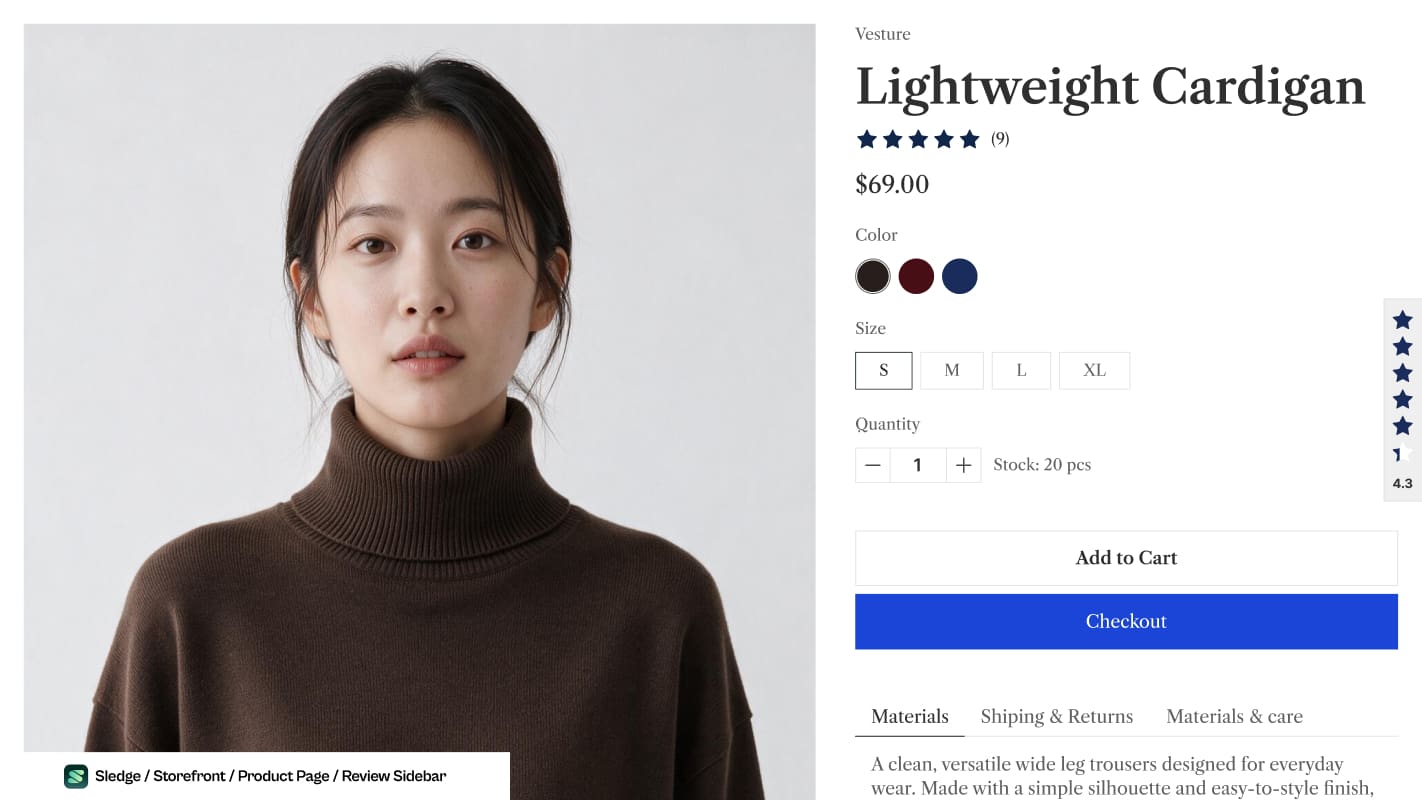
Nine reviews, shown with the rating, and one tap from any point on the page. What a shopper finds behind that tab decides whether the number means anything.
A four-point-something average with a couple of critical reviews and a reasonable reply beneath them converts better than a flawless page. The flaws are what make the rest credible.
Measuring it
- Share of products with at least five reviews, which is the metric the curve actually implies and almost nobody tracks.
- Conversion rate on products that crossed from zero to five, before and after, one product at a time.
- Review request to review rate, so you can tell a timing problem from a wording problem.
- Return and dispute rate, which honest reviews reduce, because they set expectations the product can meet.
Common questions
How do I get the first reviews with no customers?
Can I import reviews from AliExpress?
Do bad reviews hurt?
What about live visitor counters and recent-purchase popups?

The app behind these fixes
Most of Level 04 is a setting in Sledge rather than a project.
See it on the Shopify App Store