

One worked example at a 55% gross margin. The point survives any margin you substitute: the percentage is fixed, the dollars are not.
This is the lever that is not in your ad account. Break-even ROAS is fixed by your gross margin and nothing you do on the storefront changes it. What you can change is the gross profit a single order produces, and that is the number your maximum cost per acquisition is built from. A $40 order at 55% margin gives you $22 to bid with. A $62 order at the same margin gives you $34. Same ads, same CPM, same audience, and now you can outbid the people who were beating you.
Why this is the chapter Level 02 pointed at
Chapter 2.2 ended on an unfinished thought, and this is it.
You cannot lower your CPM. Meta's is up roughly 89% since 2020 and you are bidding against advertisers with more budget and better data than you have. Every lever inside the ad account is about spending the same money more precisely, and there is a floor on how much that can win you.
The lever outside the account is what a customer is worth when they arrive:
Raising order value does not improve your break-even ROAS. That is set by margin, and a bigger order at the same margin has the same ratio. What it raises is the number of dollars each conversion produces, which is what your maximum cost per acquisition is calculated from.
And cost per acquisition is what the auction actually competes on. Two stores selling the same product at the same margin, one with a $40 average order and one with a $62 average order, are not bidding on a level field. The second one can pay 55% more per customer and still make the same percentage.
You cannot win an auction by lowering your costs. You can win it by being able to afford a higher bid than the person beside you. The Dropshipping Playbook
The four levers, in order of effort
All four raise order value. They differ in how much work they are and in what they cost you in margin, which is the trade nobody puts in the table.
| Lever | Effort | Margin cost | What it needs |
|---|---|---|---|
| Free-shipping threshold | A setting | Shipping on orders above the line | A number above your current AOV |
| Progress indicator toward it | Low | None | The threshold to already exist |
| Cart upsell or add-on | Medium | None if undiscounted | A genuine complement, not a second option |
| Bundles | Highest | The bundle discount | Products that belong together |
Notice the second row. A progress indicator costs no margin at all, because it does not change your pricing or your offer. It just tells a shopper something true that they could not otherwise see: how far they are from a threshold you already set. Published threshold studies put the lift from a visible progress bar in the range of 17 to 30% on order value, though as always with vendor-adjacent figures, treat the top of that range with suspicion.
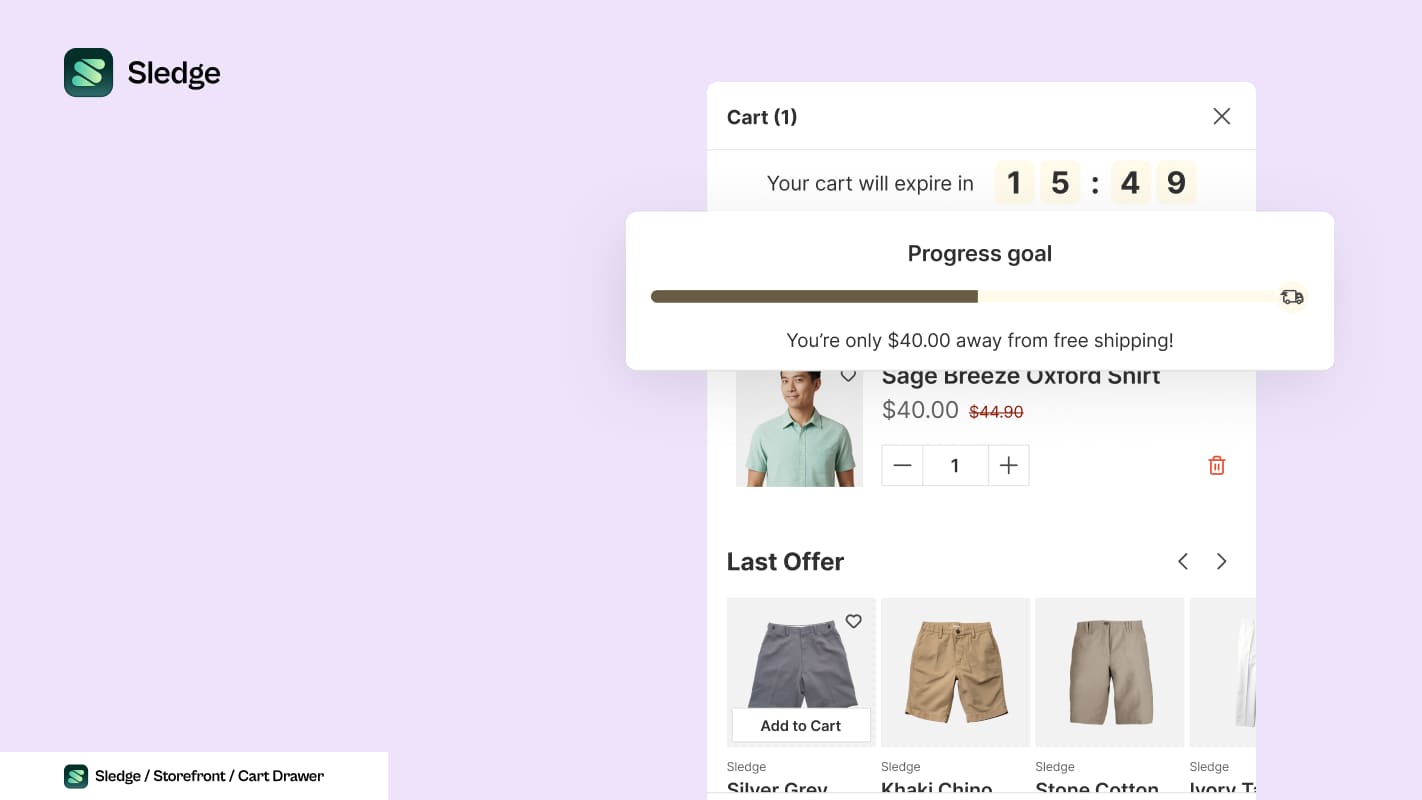
The progress bar and the upsell row in one live drawer. Neither one changed the price.
Setting the threshold, with numbers
This is the highest-yield single decision in the chapter.
Published guidance clusters around 15 to 30% above your current average order value. The reasoning behind the band is sound in both directions:
your current AOV
One caveat the guidance usually omits: the threshold has to survive your margin. A free-shipping line you cannot afford is a slow way to convert a profitable product into an unprofitable one, and chapter 2.2 is where you check that before committing.
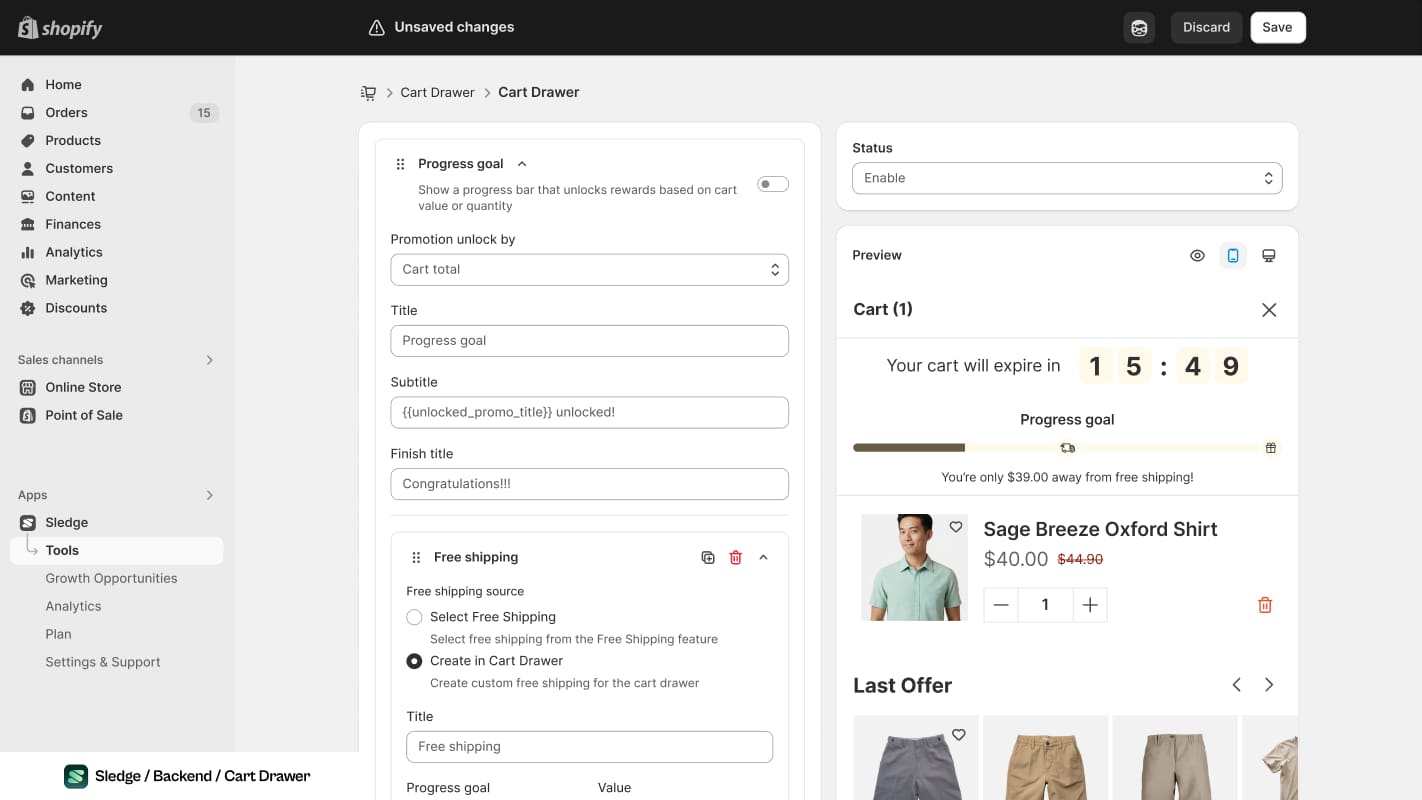
The threshold set in Sledge's cart-drawer settings, previewed live on the right as the shopper would see it.
The reason this pairs with checkout work
A threshold does two jobs at once.
It raises order value, which is this chapter. And it removes the surprise that chapter 3.3 identified as the single largest abandonment cause, because a shopper who cleared the threshold sees a shipping line of zero rather than a number they did not expect.
Almost nothing else in Level 04 improves two different layers of the funnel at once. That is why it is the first thing on the list rather than the most impressive.
What not to do
- Do not raise prices and call it AOV work. That changes margin per unit, not items per order, and it moves conversion in the wrong direction.
- Do not upsell a substitute. Offering a second version of the thing in the cart creates a decision where there was a purchase.
- Do not stack a bundle discount on top of a site-wide sale without redoing the arithmetic. Two discounts compound and the second one is usually the unprofitable one.
- Do not measure this as "revenue went up". Revenue can rise while contribution falls. Track contribution per order, per chapter 5.1.
- Do not change all four levers in the same week, or you will not know which one paid.
Where to start
- Work out your current AOV and your contribution per order. Not revenue. Revenue minus product, shipping and fees.
- Set a threshold 15 to 30% above it, once you have confirmed the margin survives free shipping on the orders that clear it.
- Make the threshold visible in the cart, with the remaining amount stated. This is the free part.
- Add one genuine complement at the cart, undiscounted, per chapter 4.3.
- Only then look at bundles, which are the highest-effort and the only lever on the list that costs margin by design. Chapter 4.2.
One at a time, with the date written down. Four changes in one week produce one number you cannot attribute and cannot repeat.
Common questions
Does raising AOV improve my ROAS?
Where should I set my free-shipping threshold?
Won't discounting for bundles cancel out the gain?
My AOV is already decent. Is this still worth doing?

The app behind these fixes
Most of Level 04 is a setting in Sledge rather than a project.
See it on the Shopify App Store