

One worked example at 55% gross margin. Substitute your own numbers before building anything: at a thinner margin the third bar can end up shorter than the first.
A bundle is the only order-value lever that costs margin by design, so it is the only one that can lose money while the revenue chart goes up. The test is one line of arithmetic: the contribution the extra item adds must exceed the discount you gave away across the whole order. At healthy margins that is usually easy and the reported lift lands somewhere around 20 to 35%. At thin margins it frequently fails, and the store finds out three months later when revenue is up and the bank balance is not.
Do the arithmetic before you design anything
Every other lever in chapter 4.1 is free or nearly free in margin terms. A bundle is not: you are choosing to sell for less than list, and that choice can be right or wrong depending on two numbers you already have.
Run it once at your own margin and the whole chapter becomes obvious. Two examples, same 10% discount:
| Gross margin | Extra item adds | 10% discount costs | Verdict |
|---|---|---|---|
| 70% | $28.00 | −$8.00 | Clearly worth it |
| 55% | $22.00 | −$8.00 | Worth it |
| 40% | $16.00 | −$8.00 | Thin, but positive |
| 25% | $10.00 | −$8.00 | $2 for twice the fulfilment risk |
| 25%, at 20% off | $10.00 | −$16.00 | Loses money on every sale |
In the last two rows, a 25% margin store running a 20% bundle discount is losing money on every bundle sold, while its revenue chart, its order count and its average order value all go up. Every dashboard number says the bundle is working.
A bundle is the only fix in this level that can raise revenue, raise order value, raise conversion, and still lose you money. The Dropshipping Playbook
This is also why chapter 1.3 put margin above every other failure. At 45 to 50% and up, most of Level 04 works. Below it, several of these fixes quietly invert.
Four bundles that survive the arithmetic
Not all bundles are the same offer. These four behave differently and fail differently.
| Type | What it is | Works when | Fails when |
|---|---|---|---|
| Complement | The thing the product needs to be used | The need is obvious to the buyer | You had to explain the connection |
| Consumable refill | More of what runs out | Repurchase cycle is short | The item lasts a year |
| Mix and match | Pick any three, save | Shoppers have a real preference to express | Margins differ across the range |
| Starter set | Everything a beginner needs | The category has a learning curve | It competes with your own hero product |
The mix-and-match failure is the one to watch, because it is invisible in the average. If your range spans a 70% margin item and a 35% margin item, a "pick any three" bundle lets a shopper assemble the worst combination for you, and some will. Cost the worst case, not the mean.
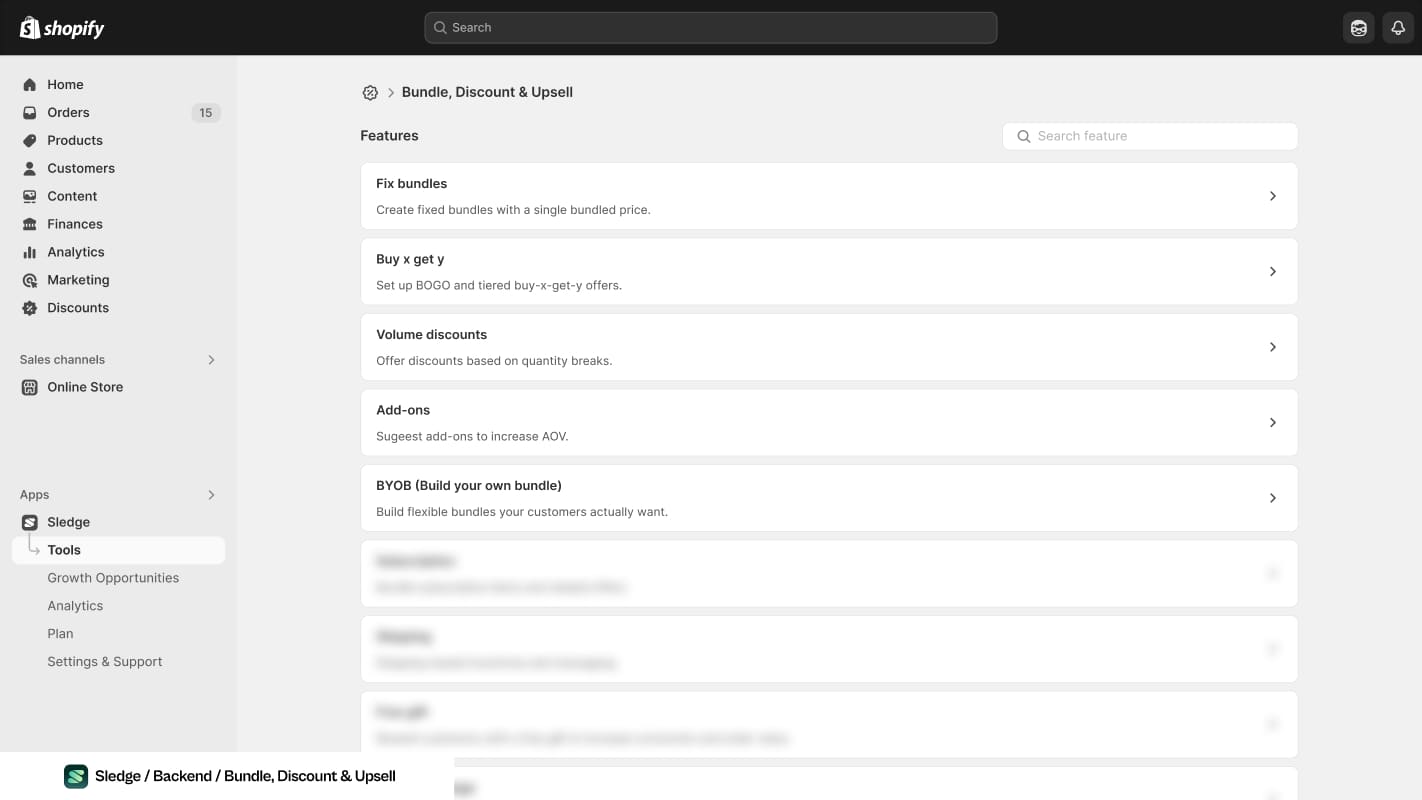
Five bundle shapes, five different worst cases to cost. The arithmetic changes with the shape.
The failure nobody catches for three months
Here is the version of this that looks like success in every report.
You bundle your best seller with a slower product at 10% off. Bundle orders climb. Average order value climbs. Revenue climbs. And single-unit orders of the best seller fall by almost exactly the number of bundles you sold.
What happened is that you took the customers who were already going to buy your hero product at full price and gave them 10% off. The second item was not incremental; it was carried along. You are now paying to discount your own best product.
Track single-unit orders of the hero product alongside bundle orders. If the first falls as the second rises, the bundle is redistributing existing demand rather than adding to it. That is a different result from the one the AOV chart is showing you.
The fix is usually to bundle around a mid-tier product rather than the hero, or to make the bundle genuinely different rather than "hero plus something."
How to build one that is testable
- Pick two products people already buy together. Check your own order data before theorising. If nobody has ever bought them in the same order, a discount will not create the relationship.
- Cost the worst case, not the average, especially for mix-and-match.
- Start at a small discount. Single digits to low teens. You can raise it; walking one back is a price rise to anyone watching.
- Show it on the product page and in the cart, not only in one place. Different shoppers decide at different moments.
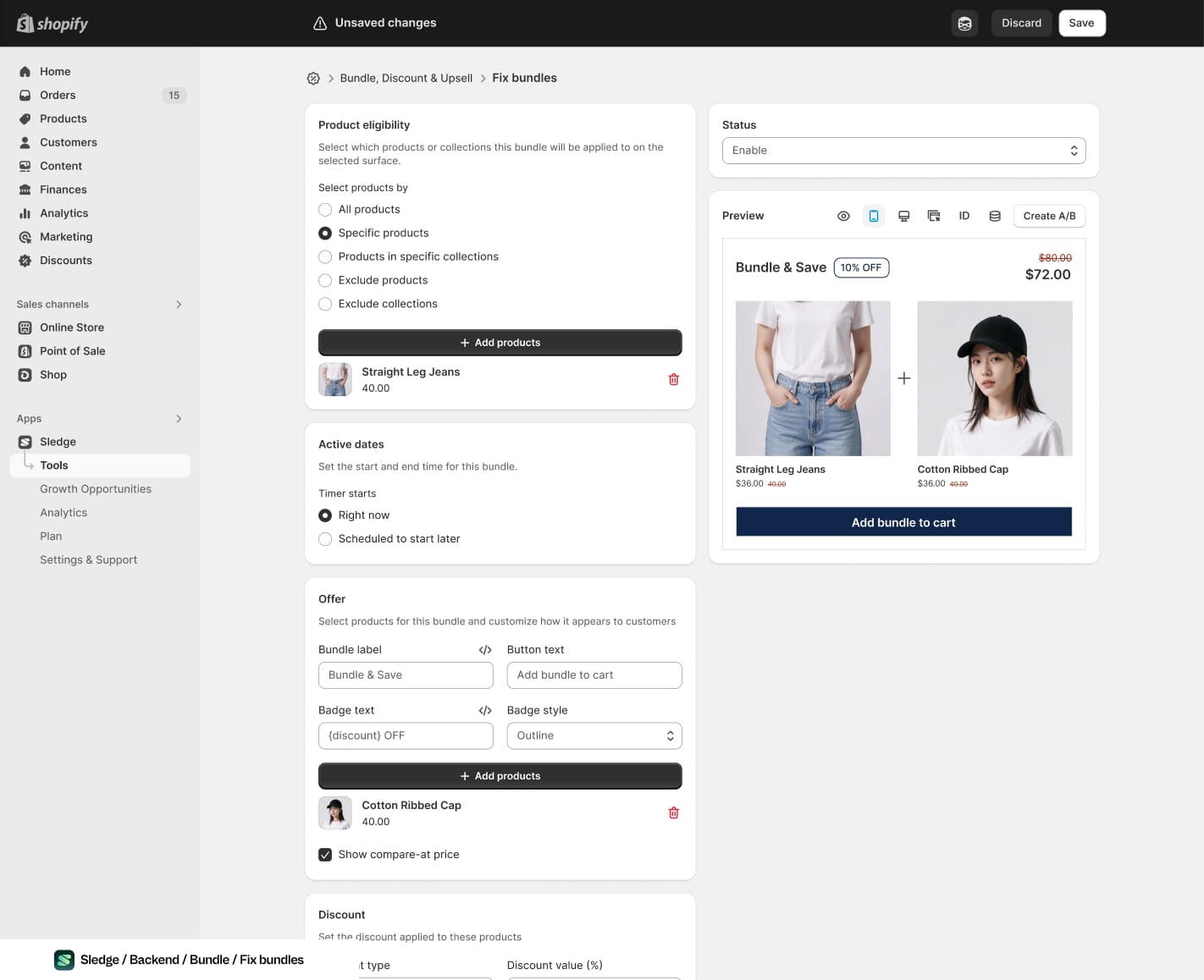
One bundle configured once, previewed as the shopper sees it. The same offer renders on the product page and in the cart.
- Record the date and change nothing else for a fortnight, per chapter 5.2.
- Judge it on contribution per order, and on hero-product single-unit orders, not on revenue or AOV alone.
Bundle buyers are frequently reported as having meaningfully higher lifetime value than single-item buyers, which is a real second-order benefit and also the kind of figure vendors like quoting. Treat it as a reason to keep a marginal bundle running rather than as a reason to start one that fails the arithmetic above.
Common questions
How big should a bundle discount be?
Should the bundle be fixed or mix-and-match?
Do bundles hurt my best seller?
Where should the bundle appear?

The app behind these fixes
Most of Level 04 is a setting in Sledge rather than a project.
See it on the Shopify App Store