

Illustrative distribution, not measured on any one store. The steepness varies; the loop underneath it does not.
Position in a collection drives views, views drive sales, and on a best-seller sort those sales drive position, which means an arbitrary starting order becomes self-confirming within weeks. Most dropshipping stores never chose a sort order at all: they inherited whatever the import produced, usually date added, and have been merchandising by accident ever since. Sorting is the cheapest lever in Level 04 because it moves revenue without changing a single product, a price or a page.
You already have a merchandising strategy
It is just probably not one you chose.
Every collection in your store has an order. If nobody set it, it is whatever the platform defaults to or whatever the import produced, which on most dropshipping stores means date added: the products you happened to import last are the ones every visitor sees first.
There is no neutral option here. A collection is a ranked list whether or not anybody ranked it, and the first row is going to take most of the attention regardless of what is in it.
There is no such thing as an unsorted collection. There is only a collection somebody sorted and a collection something sorted. The Dropshipping Playbook
The loop that makes it self-confirming
The reason this compounds rather than staying a small inefficiency:
- A product sits in the first row, so it gets most of the views.
- Getting most of the views, it gets most of the sales.
- On a best-seller sort, having most of the sales keeps it in the first row.
Within a few weeks, the initial order has become evidence for itself. A product that started at position 40 because of an import timestamp will still be at position 40, and its lack of sales will look like proof it deserves to be.
This is also the mechanism behind the revenue concentration described in chapter 3.5, where nearly all of a store's revenue sits in a handful of products. Some of that is genuine demand. Some of it is the loop above running unattended.
Keep one position in the first row for something that has not earned it yet, rotated regularly. It is a small, deliberate cost that keeps the sort correctable by evidence, rather than letting it narrow your effective catalogue to whatever won first.
What belongs at the front
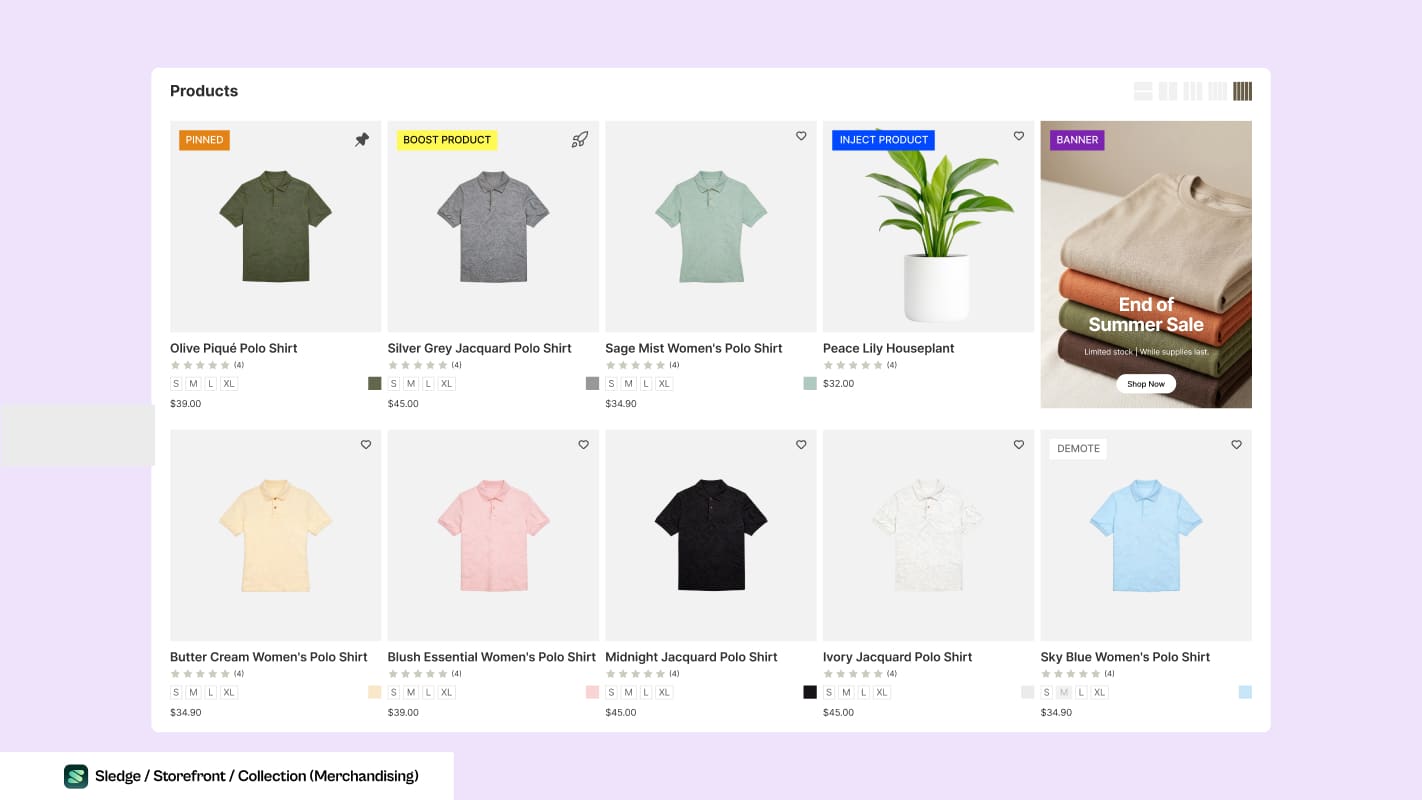
Five overrides on one grid, each placed by hand rather than earned. The table below says which products are worth spending them on.
A sort order is a set of priorities. Naming them explicitly beats picking a single rule from a dropdown.
| Position | What belongs there | Why |
|---|---|---|
| First row | Proven converters, in stock, well reviewed | This row decides the visit |
| First row, one slot | Rotation: something unproven | Keeps the sort correctable |
| Rows two and three | Range: different price points and styles | A shopper unconvinced by row one needs a different option, not more of the same |
| Anywhere but the front | Out of stock, unbuyable variants | Best position spent on a dead end |
| Anywhere but the front | Products with no reviews and no images of your own | Weakest page, best position |
Row three is the one most sorts get wrong. If your first row is four near-identical products at the same price, a shopper who does not want that thing has been shown the same answer four times. Variety in the first screen is worth more than strength in it.
Sort order changes without telling you
Chapter 3.1 listed a theme update resetting collection sort among the changes that produce no notification. It belongs on that list because it produces a revenue change with no visible cause: nothing was deleted, nothing went out of stock, no price moved. Different products simply started appearing first.
Three practical consequences:
- Record your collection sort settings in your change log, so a reset is detectable rather than mysterious
- Re-check the first row of your main collections after every theme update and every app install
- If revenue moved and nothing else explains it, open a collection page in incognito and see what is actually at the front
Where sort order does not belong
One exception, and it is the most costly place merchandising gets applied.
Not over the top of a search query. A shopper who typed a specific term has stated a constraint, and sorting those results by best seller overrides the clearest signal of intent you will get. Relevance first; popularity as the tie-break between equally good matches. Chapter 4.9 covers it in full.
The same caution applies, more mildly, to filtered views. Someone who has filtered to navy in medium has narrowed deliberately, and reordering what remains by general popularity is less harmful than in search but still answers a question they did not ask.
Testing it without fooling yourself
Sort order is unusually easy to change and unusually hard to attribute, because it affects every product in the collection at once.
- Change one collection. Leave the others as a comparison.
- Write down the date and what the previous order was, so it can be reverted exactly.
- Give it two full weeks, and compare the same weekdays, per the diagnostic in chapter 3.1.
- Judge on collection revenue and on distinct products viewed, not on whether the new first-row product sold well. Of course it did; it is in the first row.
That last point is the trap specific to this chapter. Any product you move to the front will outperform its old self, and that fact tells you nothing about whether the collection as a whole did better.
Common questions
What is the best default sort order?
Isn't best-seller sorting obviously correct?
Do out-of-stock products need to be removed?
How often should I change the sort order?

The app behind these fixes
Most of Level 04 is a setting in Sledge rather than a project.
See it on the Shopify App Store